


이화여대 이상륜 교수 연구팀, AI 기반 형상 최적화로 저주파 진동 차단과 높은 구조 강성을 동시에 구현한 격자 메타물질 개발
2026.08.12
admin
이화여자대학교 휴먼기계바이오공학부 이상륜 교수 연구팀이 인공지능(AI) 기반 형상 최적화를 활용하여 넓은 저주파 영역의 진동을 효과적으로 차단하면서도 높은 구조 강성을 유지할 수 있는 새로운 격자 메타물질(lattice metamaterial)을 개발하였다. 이번 연구 결과는 구조 및 기계공학 분야 국제학술지 Thin-Walled Structures에 게재되었다.

기계·항공우주·정밀기기 등 다양한 산업 분야에서 저주파 진동은 구조물의 피로와 성능 저하를 유발하는 주요 원인이다. 이러한 진동을 차단하기 위해 특정 주파수 영역에서 탄성파의 전달을 억제하는 메타물질이 활발히 연구되어 왔다. 그러나 기존의 저주파 진동 차단 구조는 구형 질량이나 별도의 공진 요소를 구조 내부에 배치하는 방식이 주로 활용되어, 진동 차단 영역을 넓힐수록 구조적 강성이 저하되는 한계가 있었다.
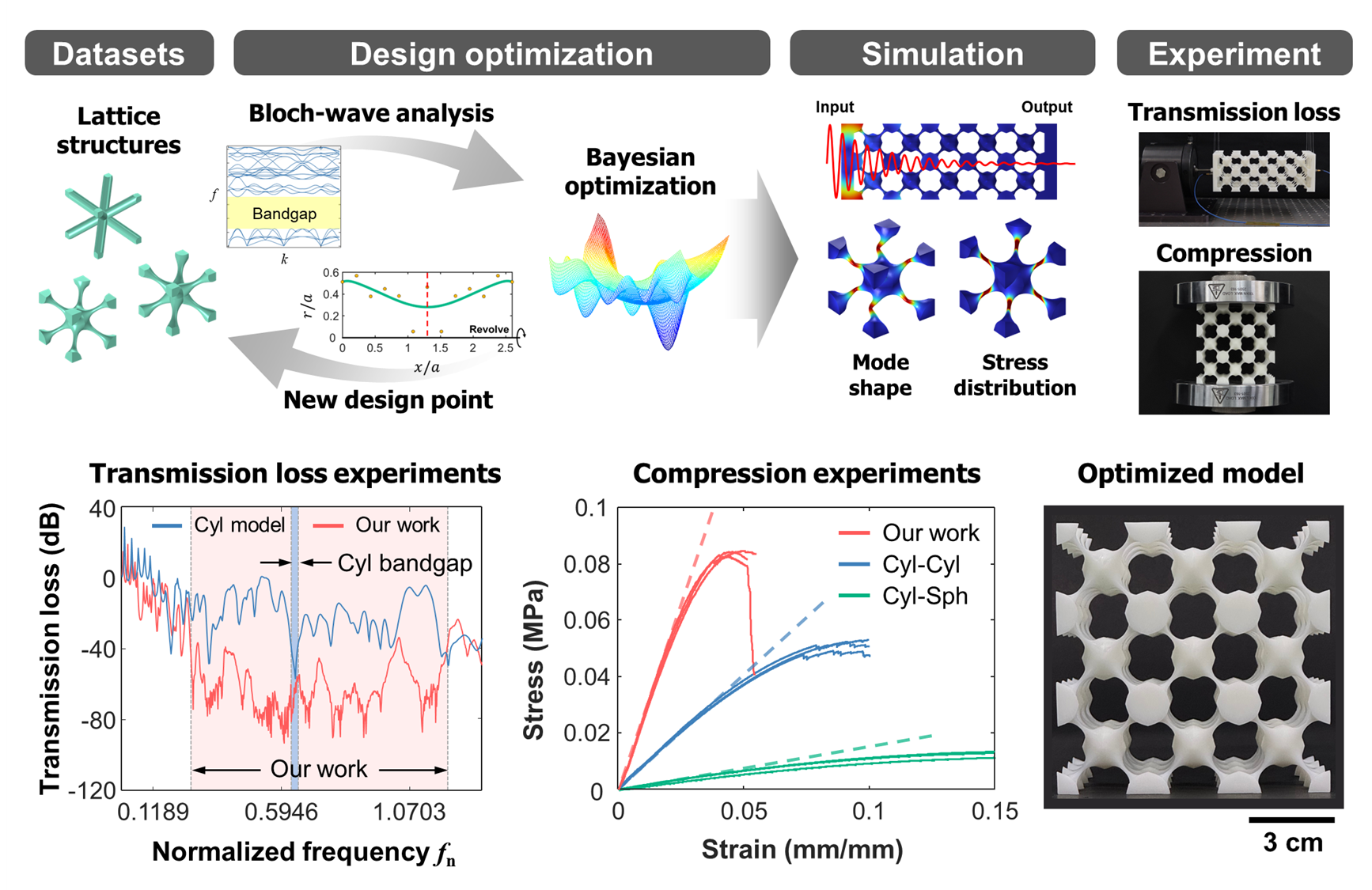
연구팀은 이러한 문제를 해결하기 위해 격자 구조를 구성하는 빔 자체의 형상을 자유롭게 변화시키는 새로운 설계 방법을 제안하였다. Bézier 곡선을 이용해 빔의 형상을 연속적으로 표현하고, Gaussian Process Regression(GPR) 기반의 Bayesian Optimization을 적용하여 저주파 진동 차단 영역을 최대화하는 최적 형상을 탐색하였다. 이를 통해 기존과 같이 별도의 공진 질량을 추가하지 않고도 빔 내부의 질량과 강성 분포를 효과적으로 조절할 수 있도록 하였다.
(사진2)
최적화된 격자 구조는 126%의 상대 밴드갭(relative bandgap)을 구현하였다. 이는 동일 조건의 일반적인 원통형 격자 구조보다 123% 넓으며, 별도의 집중 질량을 이용하는 기존 공진형 격자 구조와 비교해서도 각각 32%와 40% 넓은 값이다. 특히 최적화된 구조에서는 빔의 연속적인 형상 변화에 의해 질량과 강성이 적절하게 재분배되면서, 진동이 전달되지 않는 주파수 영역이 크게 확장되는 것으로 나타났다.
연구팀은 제안된 구조의 실제 성능을 확인하기 위해 3D 프린팅으로 격자 시편을 제작하고 진동 전달 및 압축 실험을 수행하였다. 실험에서 확인된 진동 감쇠 영역은 수치해석에서 예측된 밴드갭과 잘 일치하여 제안된 설계의 진동 차단 성능을 검증하였다. 또한 압축시험 결과, 최적화된 격자 구조는 기존 집중질량 기반 공진 구조보다 약 3.3배 및 18.9배 높은 유효 탄성계수를 나타내어, 넓은 진동 차단 성능뿐만 아니라 하중을 지지하기 위한 구조적 강성도 효과적으로 확보할 수 있음을 확인하였다.
이번 연구는 단순히 공진 요소를 추가하는 기존 방식에서 벗어나, AI를 이용해 구조 자체의 연속적인 형상을 최적화함으로써 진동 특성과 기계적 성능을 동시에 설계할 수 있다는 가능성을 제시했다는 점에서 의미가 있다. 향후 항공우주 구조물, 정밀기기, 기계 시스템 등 경량성과 구조적 안정성을 유지하면서 광대역 저주파 진동을 제어해야 하는 다양한 분야에 활용될 수 있을 것으로 기대된다.
이 논문은 정부(과학기술정보통신부)의 재원으로 한국연구재단의 지원을 받아 수행된 연구임(RS−2026–25490763, RS−2025–24803153. 본 연구는 과학기술정보통신부에서 지원하는 과학기술원 InnoCORE 사업에 의해 수행되었습니다.(N10250154).
자세한 정보와 전체 논문은 Thin-Walled Structures
(https://doi.org/10.1016/j.tws.2026.115497)를 참조하세요.
Ewha Research Team Develops AI-Optimized Lattice Metamaterial Combining Broadband Low-Frequency Vibration Attenuation with High Structural Stiffness
A research team led by Professor Sangryun Lee from the Department of Mechanical and Biomedical Engineering at Ewha Womans University has developed a new AI-optimized lattice metamaterial capable of achieving broadband low-frequency vibration attenuation while maintaining substantial structural stiffness. The research has been published in the international journal Thin-Walled Structures.
Low-frequency vibration is a persistent challenge in engineering systems, including aerospace structures, precision machinery, and mechanical systems, as it can cause structural fatigue and performance degradation. Metamaterials with phononic bandgaps have emerged as promising solutions for suppressing vibration transmission. However, conventional low-frequency resonant metamaterials often rely on discrete masses or resonators, resulting in an inherent trade-off between broadband vibration attenuation and mechanical load-bearing capability.
To overcome this limitation, the research team proposed a new design strategy in which the geometry of the lattice struts themselves is continuously optimized. The strut profiles were parameterized using Bézier curves, and a Gaussian Process Regression (GPR)-based Bayesian Optimization framework was employed to efficiently identify geometries that maximize the low-frequency phononic bandgap. This approach enables continuous redistribution of mass and stiffness along the struts without relying on additional discrete resonant masses.
The optimized lattice achieved a relative bandgap width of 126%, which is 123% larger than that of a conventional cylindrical lattice and 32% and 40% larger than those of two representative optimized discrete resonant lattice designs, respectively. The continuous geometric modulation effectively redistributes mass and stiffness along the lattice struts and delays the emergence of bandgap-closing modes, resulting in a substantially broadened vibration attenuation range.
To experimentally validate the proposed design, the researchers fabricated lattice specimens using additive manufacturing and conducted vibration transmission and quasi-static compression tests. The experimentally observed high-attenuation frequency range closely agreed with numerical predictions, confirming the broadband vibration attenuation performance of the optimized structure. Furthermore, compression experiments demonstrated that the optimized lattice exhibited effective stiffness approximately 3.3 and 18.9 times higher than those of the two conventional discrete resonant designs.
This study demonstrates a new AI-driven, geometry-based paradigm for multifunctional metamaterial design, in which wave propagation and mechanical load-bearing performance can be simultaneously tailored through continuous structural geometry optimization. The proposed approach could contribute to future lightweight vibration-control structures for aerospace systems, precision machinery, and other engineering applications requiring both structural integrity and broadband low-frequency vibration attenuation.
This paper was supported by the National Research Foundation of Korea(NRF) grant funded by the Korea government(MSIT) (RS−2026–25490763, RS−2025–24803153). This work was supported by the InnoCORE program of the Ministry of Science and ICT (N10250154).
For detailed information and the full paper, please refer to Thin-Walled Structures: https://doi.org/10.1016/j.tws.2026.115497