


김흥수 교수 연구팀, 더 안전한 교통을 위한 AI 기반 운전자 상태 모니터링 및 위험도 추정 프레임워크 개발
2026.08.31
admin
동국대학교 김흥수 교수 연구팀(제1저자: Hikmat Yar)은 운전자의 피로, 주의 산만 및 연령 관련 상태를 실시간으로 분석하여 교통 안전성을 향상시키기 위한 인공지능(AI) 기반 운전자 상태 모니터링 프레임워크를 개발하였다. 본 연구는 시간적 추론(Temporal Reasoning)과 위험도 추정(Risk Estimation) 기법을 결합하여 단일 영상 기반 분석의 한계를 극복하고, 연속적인 운전자 행동을 종합적으로 분석할 수 있는 새로운 접근법을 제안하였다. 본 연구는 컴퓨터공학 분야 국제학술지 CMES-Computer Modeling in Engineering & Sciences (SCIE, Q1) 게재가 확정되었으며, 실제 지능형 교통 시스템을 위한 AI 기반 운전자 모니터링 기술의 우수성을 인정받았다.
연구팀은 EfficientNetV2-S를 기반으로 Driver-Monitoring Coordinate Attention(DM-CA) 모듈을 설계하여 운전자의 눈, 얼굴 윤곽 등 중요한 특징을 효과적으로 학습하도록 하였으며, 시간에 따른 운전자 행동 변화를 분석하는 메모리 기반 추론 기법과 위험도 평가 모듈을 함께 적용하였다. 이를 통해 운전자 상태를 보다 정확하게 판단하고 상황에 따라 경고 및 알림을 제공할 수 있는 적응형 운전자 모니터링 시스템을 구현하였다.
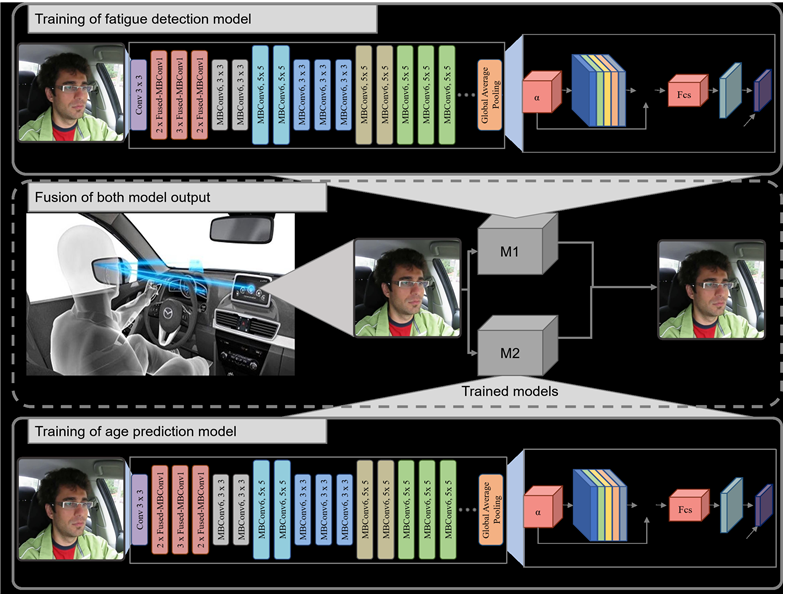
제안된 프레임워크는 UTKFace, Fatigue, Modified Fatigue 및 100-Driver 데이터셋에서 다양한 최신 연구들과 비교 평가되었으며, 정확도와 계산 효율성 측면에서 우수한 성능을 보였다. 또한 교차 검증, 통계 분석 및 계산 복잡도 평가를 통해 실제 지능형 교통 시스템과 첨단 운전자 보조 시스템(ADAS)에 적용 가능한 실용성과 일반화 성능을 입증하였다.
김흥수 교수는 "본 연구는 운전자 행동을 시간적으로 분석하고 위험도를 실시간으로 평가함으로써 기존 운전자 모니터링 기술의 한계를 극복할 수 있는 새로운 AI 기반 프레임워크를 제시하였다"며, "향후 자율주행 및 스마트 모빌리티 환경에서 보다 안전한 운전자 지원 시스템 구현에 기여할 것으로 기대된다"고 밝혔다.
본 연구는 한국연구재단(NRF) 및 과학기술정보통신부(MSIT)의 지원(RS-2025-00523019), InnoCORE 프로그램(N10260002), 그리고 교육부와 서울특별시가 지원하는 RISE 사업(2026-RISE-01-007-04)의 지원을 받아 수행되었다.
Professor Heung Soo Kim's Research Team Develops an AI-Based Driver State Monitoring and Risk Estimation Framework for Safer Transportation
The research team led by Professor Heung Soo Kim at Dongguk University has developed an artificial intelligence (AI)-based driver state monitoring framework that enhances road safety by analyzing driver fatigue, distraction, and other driver state indicators in real time. The proposed framework combines temporal reasoning and dynamic risk estimation to overcome the limitations of conventional frame-based driver monitoring systems. This research has been accepted for publication in CMES-Computer Modeling in Engineering & Sciences (SCIE, Q1), recognizing the excellence of the proposed AI-based driver monitoring technology for real-world intelligent transportation systems.
The framework employs EfficientNetV2-S with a Driver-Monitoring Coordinate Attention (DM-CA) module to improve spatial feature representation while incorporating temporal memory and reasoning to analyze driver behavior over sequential frames. A risk-aware decision module further enables adaptive interventions, including timely warnings and alerts based on driver conditions and driving context.
The proposed method was extensively evaluated on the UTKFace, Fatigue, Modified Fatigue, and 100-Driver datasets, demonstrating superior accuracy, computational efficiency, and robustness compared with state-of-the-art approaches. Comprehensive validation, including cross-validation, statistical analysis, and computational complexity evaluation, confirms its suitability for real-world intelligent transportation systems and advanced driver assistance systems (ADAS).
This work was supported by the National Research Foundation of Korea (NRF) grant funded by the Korea Government (Ministry of Science and ICT, MSIT) (RS-2025-00523019), the InnoCORE Program of the Ministry of Science and ICT (N10260002), and the Regional Innovation System & Education (RISE) program through the Seoul RISE Center, funded by the Ministry of Education (MOE) and the Seoul Metropolitan Government (2026-RISE-01-007-04).