


이수영 교수, 기계인공지능 전문가 심포지엄서 Industrial Physical AI를 위한 공학적 접근 소개
2026.09.10
admin
중앙대학교 기계공학부 이수영 교수가 2026년 8월 19일 고려대학교 서울캠퍼스에서 열린 ‘대한기계학회 기계인공지능 전문가 심포지엄’에서 ‘Industrial Physical AI for Engineering-Grounded Autonomy’를 주제로 발표했다. 이번 심포지엄은 대한기계학회가 주최하고 대한기계학회 기계인공지능연구회가 주관했다.
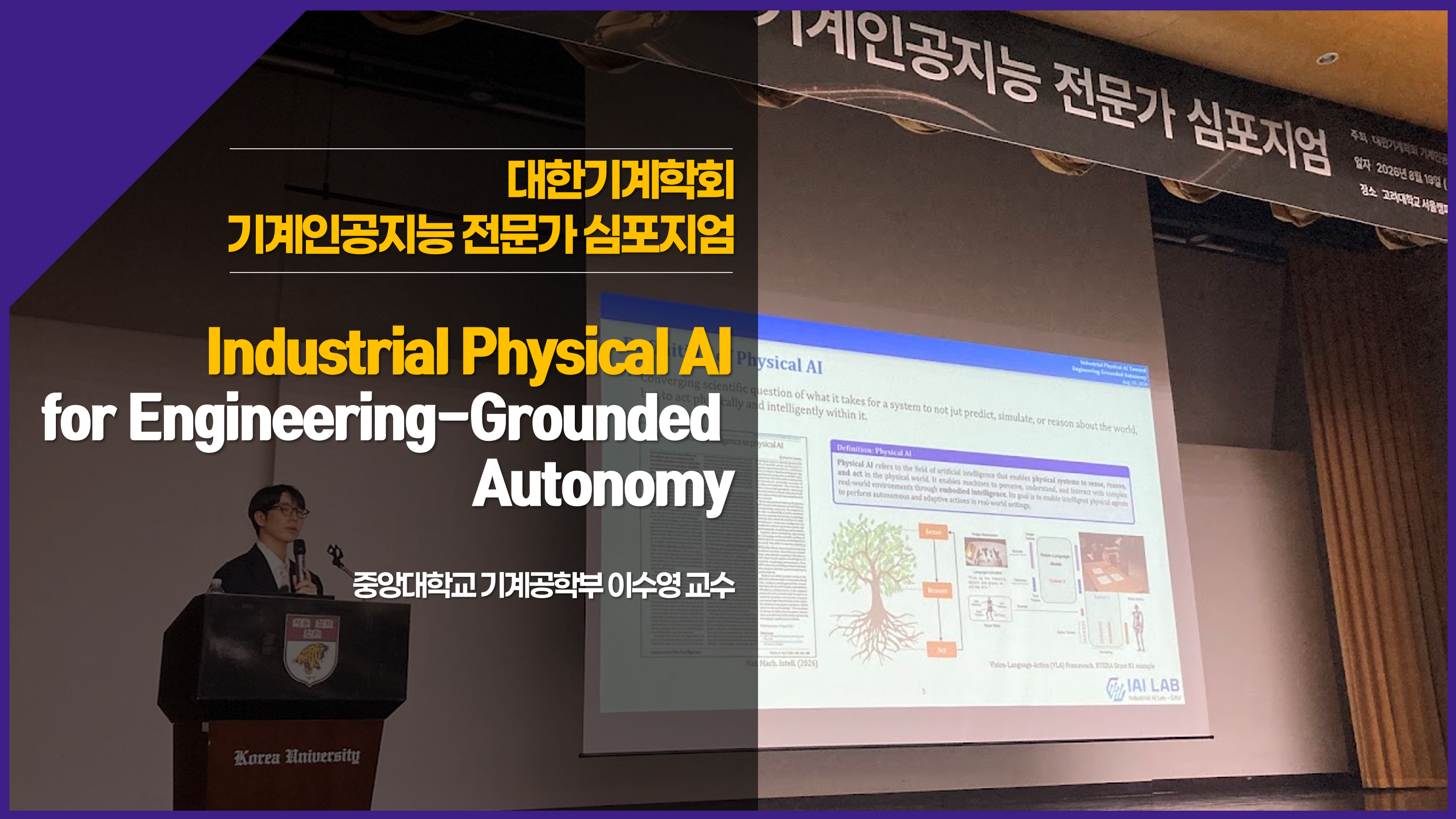
이수영 교수는 Industrial Physical AI를 구현하기 위한 공학적 접근으로 ▲도메인 특성을 반영한 학습과 모델링 방법 ▲소프트웨어와 하드웨어를 통합적으로 고려한 피지컬 AI 설계 ▲물리성에 기반한 물리적 피지컬 AI 등 세 가지 관점을 제시했다.
해당 발표를 통해 연구실에서 수행 중인 다양한 Physical AI 연구 사례를 소개했다. 주요 연구로는 분해 과정을 활용한 조립 학습, 숙련자의 용접 동작을 해석 가능한 형태로 표현하는 정밀 행동 모델링, 대상 물체의 특성에 맞춘 적응형 그리퍼 설계 등이 제시됐다. 특히 이수영 교수는 단순한 행동 예측을 넘어 행동 이후 발생하는 물리적 결과까지 추론하고 이를 의사결정에 활용할 수 있는 ‘Extended Physical AI’ 개념을 최초로 제안했다.
이수영 교수는 Physical AI의 산업적 활용을 확대하는 과정에서 실제 시스템과 물리 현상을 다루는 기계공학의 역할이 중요하다고 강조하며, 향후 기계공학을 기반으로 인공지능과 로보틱스, 제조 기술을 융합해 실제 산업 현장에서 활용 가능한 Physical AI 기술을 구현하는 것이 중요하다고 밝혔다.
자세한 내용과 전체 발표 내용은 기계인공지능 전문가 심포지엄 발표 영상(https://youtu.be/AshdDPMIYfQ?si=K-Lb4U68t6xDdlXp)을 참조하세요.
Professor Sooyoung Lee Presents Engineering-Grounded Approaches to Industrial Physical AI at KSME Symposium
Professor Sooyoung Lee of the School of Mechanical Engineering at Chung-Ang University delivered a presentation titled “Industrial Physical AI for Engineering-Grounded Autonomy” at the Mechanical AI Expert Symposium held at Korea University’s Seoul Campus on August 19, 2026. The symposium was hosted by the Korean Society of Mechanical Engineers (KSME) and organized by its Mechanical Artificial Intelligence Research Group.
In his presentation, Professor Lee outlined three engineering perspectives for realizing Industrial Physical AI: ▲ learning and modeling approaches that incorporate domain-specific characteristics, ▲ Physical AI design that jointly considers software and hardware, and ▲ physically grounded Physical AI based on the inherent properties and dynamics of physical systems.
Professor Lee also introduced a range of Physical AI research projects currently being conducted in his laboratory. Key examples included learning assembly tasks from disassembly processes, precise behavior modeling that represents expert welding motions in an interpretable form, and the design of adaptive grippers tailored to the characteristics of target objects.
In particular, Professor Lee introduced the concept of “Extended Physical AI,” which goes beyond simply predicting actions by reasoning about the physical outcomes that follow those actions and incorporating such predictions into decision-making. This concept expands the scope of Physical AI from action generation to a deeper understanding of action–consequence relationships in the physical world.
Professor Lee emphasized the critical role of mechanical engineering—which directly addresses real-world systems and physical phenomena—in expanding the industrial applications of Physical AI. He noted that advancing practical Physical AI for real-world industrial environments will require the integration of artificial intelligence, robotics, and manufacturing technologies on a strong foundation of mechanical engineering.
For further details and the full presentation, please refer to the symposium presentation video:
https://youtu.be/AshdDPMIYfQ?si=K-Lb4U68t6xDdlXp