


이수영 교수 연구팀, LLM 기반 설계·해석·제조 통합 자율화 멀티에이전트 기술 개발
2026.09.11
admin

중앙대학교 기계공학부 이수영 교수 연구팀은 여러 인공지능(AI) 에이전트가 각자의 전문 역할을 수행하고 상호 협업하며 제품 설계부터 성능 평가, 제조 의사결정까지 전 과정을 자율적으로 수행하는 거대 언어 모델(Large Language Model, LLM) 기반 멀티에이전트 프레임워크를 개발하였다. 본 연구는 개별 공정이나 업무에 국한됐던 기존 AI 활용 방식을 넘어, 산업 전주기의 복합적인 의사결정을 AI가 자율적으로 수행하는 ‘자율 엔지니어링(Autonomous Engineering)’으로 확장할 수 있는 기술적 기반을 제시했다는 점에서 의의가 있다. 연구 결과는 세계 권위 학술지인 Journal of Industrial Information Integration (Impact Factor: 11.2) 에 게재되었다.
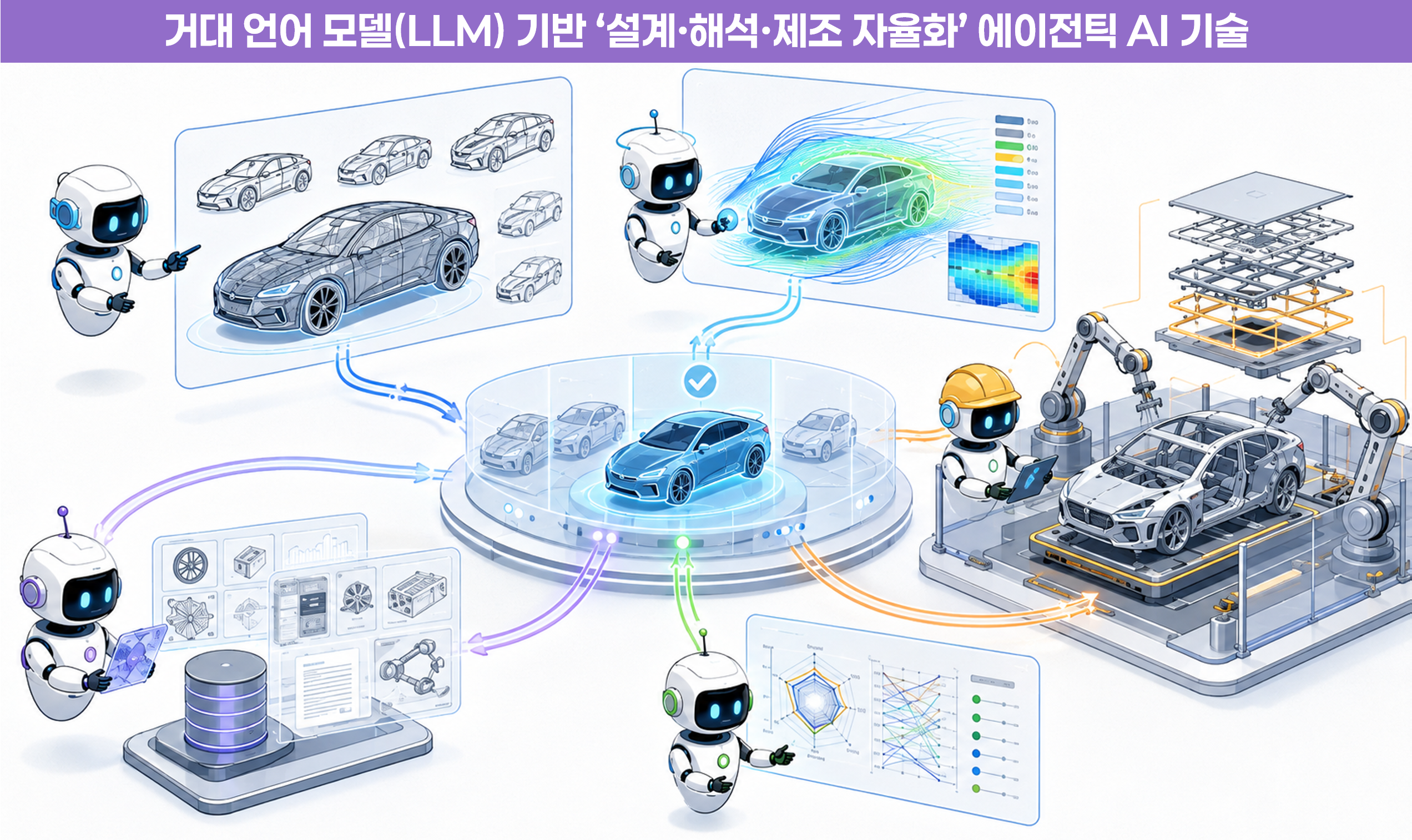
본 연구는 기존의 설계·제조 과정이 개별 단계 중심으로 이루어져 단계 간 정보가 단절되고 반복적인 의사결정이 필요하다는 한계를 극복하기 위해 LLM 기반 멀티에이전트 기반 에이전틱 AI 기술을 제안하였다. 연구팀은 설계, 성능 평가, 제조 의사결정 등 각 분야를 담당하는 전문 AI 에이전트들이 서로 정보를 공유하고 결과를 검증하며 하나의 목표를 향해 협업하도록 하였다. 이를 통해 각 단계를 개별적으로 자동화하는 것을 넘어, 설계부터 제조까지 전 과정을 자율적으로 연결하고 의사결정을 수행할 수 있는 통합 엔지니어링 프레임워크를 구현하였다.
이수영 교수는 “본 연구는 AI가 개별 업무를 수행하는 수준을 넘어, 서로 다른 전문성을 가진 여러 AI가 하나의 엔지니어링 조직처럼 협력하며 복잡한 의사결정을 스스로 이어갈 수 있음을 보여줬다는 점에서 의미가 있다”며, “향후 자동차뿐만 아니라 반도체, 에너지, 우주항공 등 다양한 산업 분야로 확장해 AI 기반 자율 엔지니어링 기술로 발전시킬 수 있을 것으로 기대한다”고 밝혔다.
본 연구는 한국연구재단 및 과학기술정보통신부(RS-2024-00342929), 산업통상부 산업기술혁신사업 알키미스트 프로젝트(20025702), 그리고 과학기술정보통신부 InnoCORE 프로그램(N10260002)의 지원을 받아 수행되었다.
자세한 정보와 전체 논문은 Journal of Industrial Information Integration (https://doi.org/10.1016/j.jii.2026.101193)을 참고하세요
Professor Sooyoung Lee’s Research Team Develops an LLM-Based Multi-Agent Framework for Autonomous Integration of Design, Analysis, and Manufacturing
A research team led by Professor Sooyoung Lee of the School of Mechanical Engineering at Chung-Ang University (first author: Hoonhyung Chung) has developed, for the first time, a large language model (LLM)-based multi-agent framework in which multiple artificial intelligence (AI) agents perform specialized roles and collaborate with one another to autonomously carry out the entire engineering process, from product design and performance evaluation to manufacturing decision-making. Moving beyond conventional AI approaches that are limited to individual processes or tasks, this study provides a technological foundation for extending AI toward Autonomous Engineering, in which AI can autonomously perform complex decision-making across the entire industrial lifecycle. The research was published in the internationally renowned journal Journal of Industrial Information Integration (Impact Factor: 11.2).
This study proposes an LLM-based multi-agent Agentic AI framework to overcome the limitations of conventional design and manufacturing processes, where individual stages are often disconnected and repetitive decision-making is required. The research team developed a collaborative structure in which specialized AI agents responsible for design, performance evaluation, and manufacturing decision-making share information, validate one another’s outputs, and work together toward a common objective. Through this approach, the team implemented an integrated engineering framework capable of autonomously connecting the entire process from design to manufacturing and performing coordinated decision-making, going beyond the automation of individual stages.
Professor Sooyoung Lee stated, “This study is significant in demonstrating that AI can move beyond performing isolated tasks and that multiple AI agents with different areas of expertise can collaborate like a single engineering organization to autonomously carry out complex decision-making.” He added, “We expect this technology to evolve into an AI-based Autonomous Engineering technology that can be extended beyond the automotive industry to a wide range of industrial fields, including semiconductors, energy, and aerospace.”
This work was supported by the National Research Foundation of Korea (NRF) and the Ministry of Science and ICT (MSIT) (RS-2024-00342929), the Alchemist Project under the Industrial Technology Innovation Program funded by the Ministry of Trade, Industry and Energy (MOTIE) (20025702), and the InnoCORE Program funded by the Ministry of Science and ICT (MSIT) (N10260002).
For more information and access to the full article, please refer to Journal of Industrial Information Integration (https://doi.org/10.1016/j.jii.2026.101193)