


유승화 교수 연구팀, 열전발전기 소재 발굴부터 구조 최적화, 수명 신뢰성까지 아우르는 계산 기반 통합 리뷰 발표
2026.09.29
admin
KAIST 기계공학과 유승화 교수와 한국전기연구원(KERI) 류병기 박사 공동연구팀은 폐열을 전기로 직접 변환하는 열전발전기(Thermoelectric Generator, TEG) 연구를 소재 발굴, 소자 및 시스템 최적화, 장기 신뢰성의 세 축으로 통합 정리한 종합 리뷰 논문을 발표하였다. 본 연구는 그동안 응용 분야나 성능지수(ZT) 향상 등 개별 주제에 머물렀던 기존 리뷰와 달리, 계산 기반 방법론을 중심으로 세 영역을 하나의 설계 흐름으로 연결했다는 점에서 의의가 있다. 연구 결과는 에너지 분야 권위 학술지인 Renewable and Sustainable Energy Reviews (Impact Factor: 16.3)에 게재되었다.
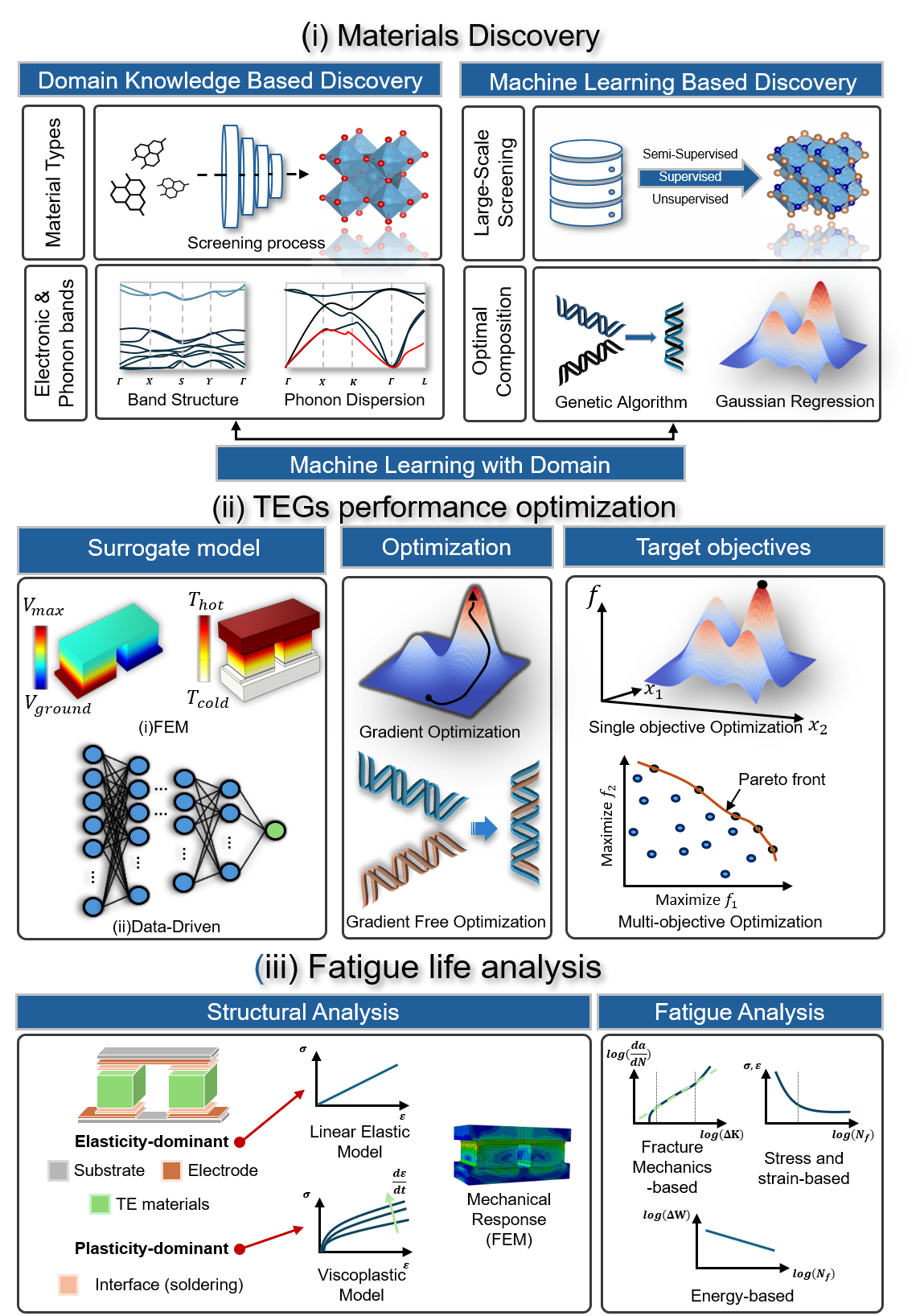
열전발전기는 움직이는 부품 없이 온도차만으로 전기를 생산할 수 있어 소형 센서부터 산업 폐열 회수까지 폭넓게 활용될 수 있지만, 낮은 변환 효율과 열 사이클 환경에서의 기계적 내구성 부족이 상용화의 걸림돌로 지적되어 왔다. 연구팀은 이 문제를 풀기 위해 먼저 물리 기반 경험 법칙에서 출발해 고처리량 계산과 머신러닝을 활용한 데이터 기반 열전소재 탐색 기법을 정리하고, 능동학습, PU 학습, 베이지안 최적화 등 적은 데이터로도 유망 소재를 찾아내는 전략과 데이터 편향, 분포 외 일반화 문제에 대한 대응 방안을 함께 제시하였다. 이어 해석 모델, 유한요소해석, 머신러닝 대리모델을 활용한 소자 및 시스템 수준의 성능 예측과 위상 최적화를 포함한 다양한 최적화 기법을 비교하고, 계면 저항과 복사 및 대류 손실처럼 실제 효율을 떨어뜨리는 요인을 설계 단계에서 반영해야 함을 강조하였다. 마지막으로 열팽창계수 차이로 가장 취약한 계면 부위를 중심으로 점소성 구성 모델과 에너지 기반 피로 수명 모델을 결합한 신뢰성 평가 방법을 정리하였다.
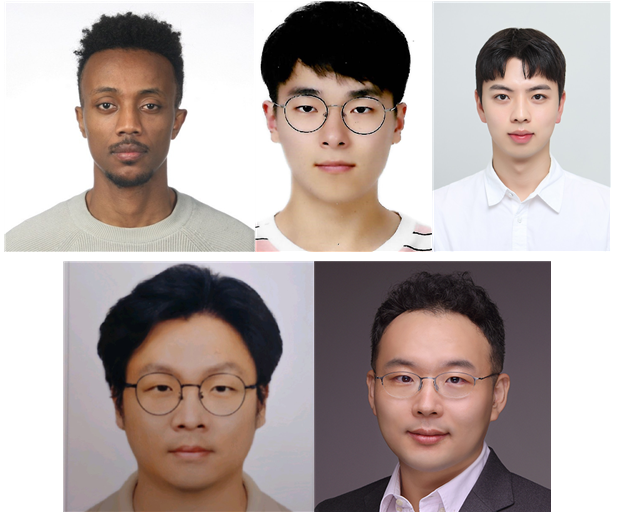
이번 논문은 KAIST 기계공학과 Wabi Demeke, 이준형, 이인효 연구원이 공동 제1저자로 참여하였으며, KAIST 유승화 교수와 한국전기연구원 류병기 박사가 공동 교신저자로 연구를 이끌었다.
본 연구는 과학기술정보통신부 InnoCORE 프로그램(N10260002), 한국재료연구원 기본사업, 그리고 한국연구재단(RS-2025-16070951, RS-2023-00222166)의 지원을 받아 수행되었다.
자세한 정보와 전체 논문은 Renewable and Sustainable Energy Reviews (https://doi.org/10.1016/j.rser.2026.117459) 를 참고하세요.
Professor Seunghwa Ryu's Research Team Publishes a Computational Review Unifying Materials Discovery, Structural Optimization, and Service Life Reliability of Thermoelectric Generators
A joint research team led by Professor Seunghwa Ryu of the Department of Mechanical Engineering at KAIST and Dr. Byungki Ryu of the Korea Electrotechnology Research Institute (KERI) has published a comprehensive review that integrates thermoelectric generator (TEG) research across three interconnected domains: materials discovery, device and system-level optimization, and long-term reliability. Unlike previous reviews that focused on individual topics such as application areas or ZT enhancement, this work connects the three domains into a single design pipeline centered on computational methodologies. The review was published in Renewable and Sustainable Energy Reviews (Impact Factor: 16.3).
TEGs convert waste heat directly into electricity without moving parts, making them attractive for applications ranging from micro-scale sensors to industrial heat recovery. However, limited conversion efficiency and insufficient mechanical durability under thermal cycling have hindered their widespread deployment. The review first surveys the evolution of thermoelectric materials discovery from physics-based heuristics to data-driven screening enabled by high-throughput simulations and machine learning, highlighting data-efficient strategies such as active learning, positive-unlabeled learning, and Bayesian optimization, along with approaches to address dataset bias and out-of-distribution generalization. It then compares performance prediction and optimization techniques at the device and system levels, including analytical models, finite element methods, ML-based surrogate models, and topology optimization, emphasizing the need to account for interfacial resistance and radiative and convective losses. Finally, it reviews reliability assessment strategies for the structurally vulnerable interfaces, combining viscoplastic constitutive models with energy-based fatigue life frameworks.
Wabi Demeke, Junhyeong Lee, and Inhyo Lee of KAIST contributed equally as co-first authors, and Professor Seunghwa Ryu and Dr. Byungki Ryu served as co-corresponding authors.
This work was supported by the InnoCORE Program (N10260002), the Fundamental Research Program of the Korea Institute of Materials Science (KIMS), and grants from the National Research Foundation of Korea (RS-2025-16070951, RS-2023-00222166), all funded by the Ministry of Science and ICT (MSIT).
For more information and access to the full article, please refer to Renewable and Sustainable Energy Reviews (https://doi.org/10.1016/j.rser.2026.117459)