


유승화·김산하 교수 공동 연구팀, 형제가 함께 물리 법칙만으로 메타물질을 설계하는 AI 개발
2026.09.28
admin
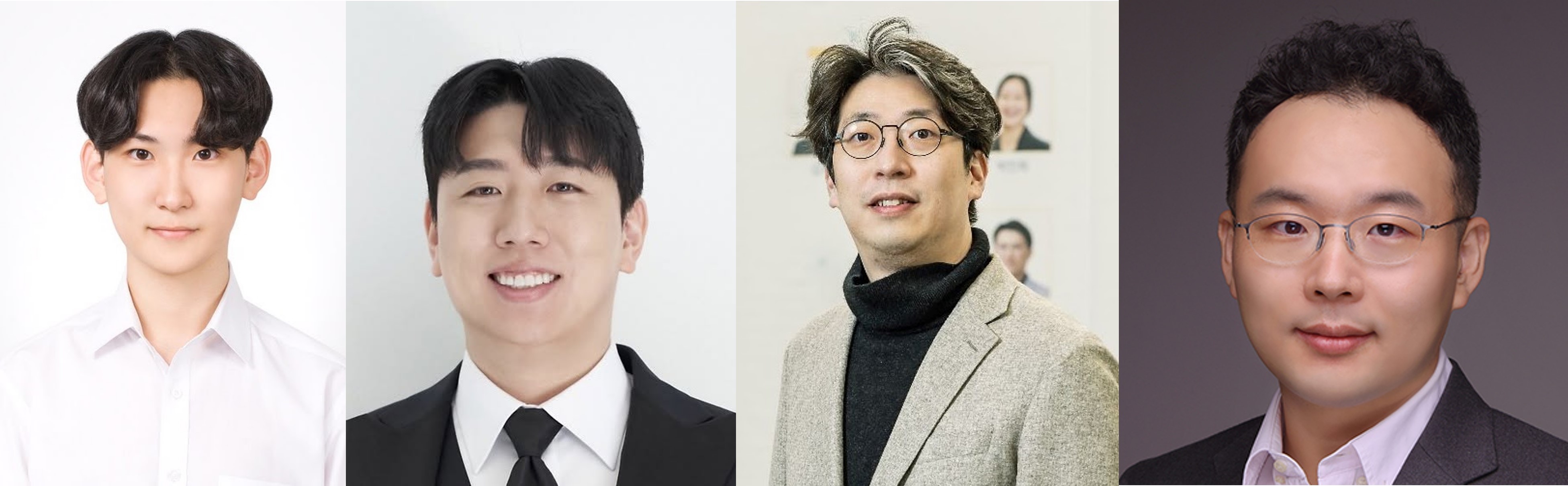
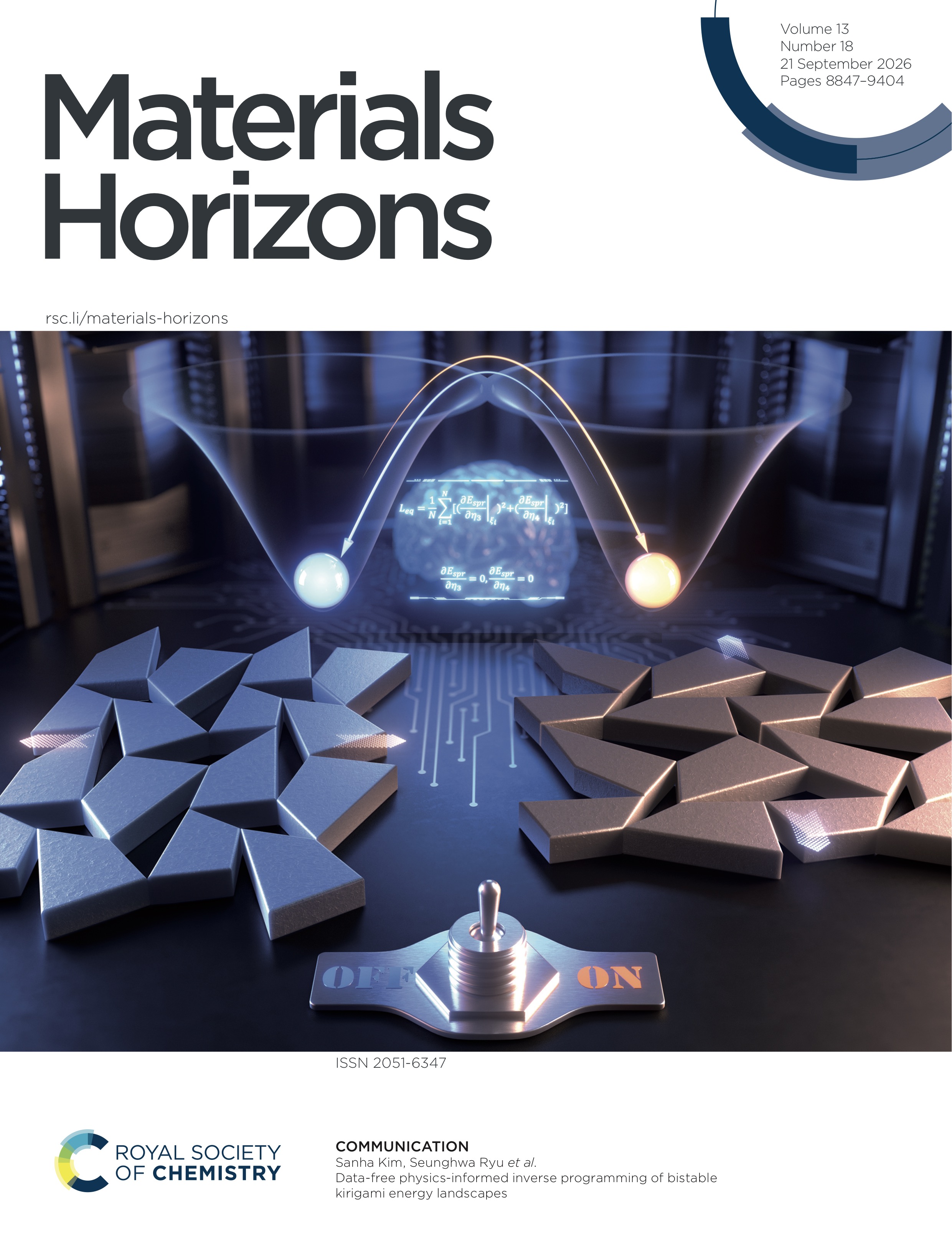
기계공학과 강석헌 박사과정(지도교수: 유승화)과 이노코어 강석경 박사후연구원(지도교수: 김산하)이 참여한 공동 연구가 국제학술지 Materials Horizons에 게재되고 해당 호의 표지 논문(Front Cover)으로 선정되는 성과를 거두었다.
논문 제목: Data-free physics-informed inverse programming of bistable kirigami energy landscapes
키리가미(kirigami)는 종이에 칼집을 내어 접고 펼치는 종이공예에서 착안한 구조로, 평면 시트에 정교한 절개 패턴을 넣어 다양한 형태로 변형시키는 메타물질 설계 기법이다. 이 중에서도 두 가지 안정된 형태(이중안정성, bistability) 사이를 오갈 수 있는 구조는 외부 힘 없이도 정해진 형태를 유지하거나 전환할 수 있어, 접이식 구조물, 소프트 로봇 액추에이터, 충격 완화 장치 등 다양한 분야에 활용될 수 있는 핵심 소재로 주목받고 있다.
기존에는 원하는 성능을 얻기 위해 구조의 형상을 먼저 정한 뒤 반복적인 시뮬레이션으로 결과를 확인하는 방식이 주로 쓰였다. 최근에는 데이터 기반 인공지능 모델로 설계 과정을 단축하려는 시도도 있었지만, 이를 위해서는 방대한 사전 시뮬레이션 데이터셋을 미리 확보해야 한다는 한계가 있었다.
연구팀은 별도의 사전 데이터 없이도, 힘의 평형 조건과 에너지 관계식, 기하학적 정합 조건 등 물리 법칙을 신경망의 학습 목적함수에 직접 포함시키는 '물리 정보 신경망(Physics-Informed Neural Network, PINN)' 프레임워크를 제안했다. 이 프레임워크는 목표로 하는 에너지 장벽(energy barrier)과 변형 형태만 입력하면 이를 만족하는 키리가미 구조의 형상을 역으로 설계(inverse design)할 수 있으며, 에너지 장벽 값과 두 안정 상태만 주어진 최소한의 조건(minimally specified setting)에서도 전체 에너지 지형을 스스로 추론해낼 수 있다는 점이 특징이다.
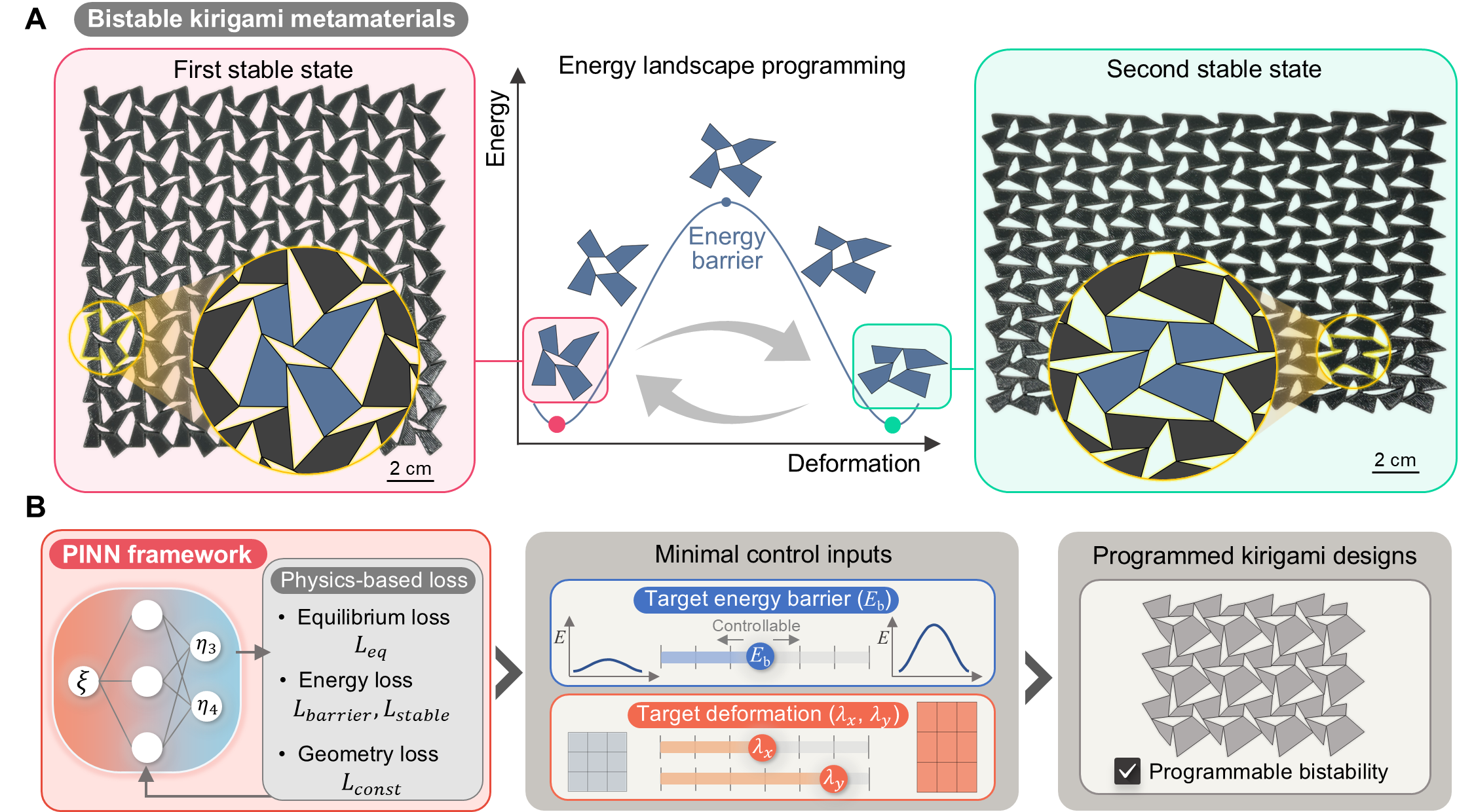
이번 연구는 키리가미 구조의 설계 방식을 기존의 '형상 중심'에서 '에너지 지형 중심'으로 전환했다는 점에서 의미가 있다. 목표로 하는 에너지 특성을 직접 지정해 여러 개의 형상학적으로 다른 해를 얻을 수 있어 설계 유연성이 크게 향상됐다. 연구팀은 이 프레임워크가 접이식 구조물, 소프트 로봇 액추에이터, 충격 완화 장치 등 다양한 이중안정 메타물질 시스템의 설계에 폭넓게 활용될 수 있을 것으로 기대하고 있다.
이번 연구에는 친형제인 강석헌 박사과정과 강석경 박사가 함께 참여했다. 각자의 연구 분야에서 쌓아온 경험을 바탕으로 물리 기반 AI를 활용한 메타물질 설계 연구를 공동으로 수행했다. 강석경 박사의 한양대학교 ERICA 교수 임용 이후에도 두 사람은 AI 기반 설계와 제조 분야를 중심으로 공동 연구를 지속할 예정이다. 강석헌 박사과정과 강석경 교수는 “형제가 함께 연구 성과를 낼 수 있어 의미가 있었다”며 “앞으로도 서로의 강점을 접목할 수 있는 연구를 지속해 나가겠다”고 말했다.
한편, 이번 연구는 과학기술정보통신부(MSIT) 산하 한국연구재단(NRF)의 지원(과제번호 RS-2023-00222166, RS-2025-02213804), 교육부 산하 한국연구재단 기초연구사업(과제번호 RS-2025-25406725), 과학기술정보통신부 이노코어(InnoCORE) 사업(과제번호 N10260002), 식품의약품안전처의 지원(과제번호 RS-2023-00215667)을 받아 수행됐다.
Joint Research Team Led by Professors Seunghwa Ryu and Sanha Kim Develops AI for Physics-Only Metamaterial Design with Brother Researchers
PhD candidate Sukheon Kang (advisor: Prof. Seunghwa Ryu) and Dr. Sukkyung Kang (advisor: Prof. Sanha Kim) of our department participated in a joint study published in the international journal Materials Horizons, which was also selected as the Front Cover of the issue.
Paper title: Data-free physics-informed inverse programming of bistable kirigami energy landscapes
Kirigami refers to structures inspired by the traditional paper craft of cutting slits into paper, in which precisely designed cut patterns are introduced into flat sheets to enable various shape transformations — a metamaterial design technique. Among these, structures capable of switching between two stable configurations (bistability) can maintain or transition between predetermined shapes without external force, drawing attention as a key material for applications such as deployable structures, soft robotic actuators, and impact-mitigation devices.
Conventional approaches typically fixed the structural geometry first and then verified the resulting performance through repeated simulations. More recently, data-driven AI models have been used to shorten this design process, but such approaches require large, pre-collected simulation datasets.
Without relying on any pre-collected data, the research team proposed a physics-informed neural network (PINN) framework that directly embeds physical laws — force equilibrium conditions, energy formulations, and geometric compatibility constraints — into the network's training objective. Given only a target energy barrier and desired deformation, the framework can inversely design a kirigami geometry that satisfies these conditions, and it can even infer the full energy landscape from a minimally specified setting in which only the target energy barrier and the two stable states are given.
This work is significant in that it shifts the design paradigm for kirigami structures from a "geometry-first" approach to an "energy-landscape-first" approach. By directly specifying target energy characteristics, multiple geometrically distinct solutions can be obtained, greatly improving design flexibility. The research team expects this framework to be broadly applicable to the design of various bistable metamaterial systems, including deployable structures, soft robotic actuators, and impact-mitigation devices.
This study is also notable for having been carried out jointly by biological brothers — PhD candidate Sukheon Kang and Dr. Sukkyung Kang. Drawing on the experience each has built in their respective fields, the two conducted joint research applying physics-based AI to metamaterial design. Even after Dr. Kang's appointment as a professor at Hanyang University's ERICA campus, the brothers plan to continue their collaboration, centered on AI-based design and manufacturing. PhD candidate Sukheon Kang and Prof. Sukkyung Kang said, "It was meaningful to be able to produce research results together as brothers," adding, "We plan to continue pursuing research that combines each other's strengths going forward.“
This work was supported by the National Research Foundation of Korea (NRF) funded by the Ministry of Science and ICT (MSIT) (Grant Nos. RS-2023-00222166 and RS-2025-02213804), the Basic Science Research Program through the National Research Foundation of Korea (NRF) funded by the Ministry of Education (Grant No. RS-2025-25406725), the InnoCORE Program of the Ministry of Science and ICT (Grant No. N10260002), and a grant from the Ministry of Food and Drug Safety (Grant No. RS-2023-00215667).