


다중충실도 최적화 기반 AI 반도체 냉각 기술 개발 및 냉각 효율 10배 향상
2026.10.30
admin
KAIST AX학과 이익진 교수 연구팀은 기계공학과 김성진 교수 연구팀과 공동으로 다중충실도(Multi-fidelity) 모델링 및 최적화 기술을 활용하여 차세대 AI 반도체를 위한 초고효율 액체 냉각 기술을 개발하였다. 해당 연구 성과는 KBS 뉴스 등 주요 언론을 통해 소개되었다.
(뉴스 링크 : https://news.kbs.co.kr/news/pc/view/view.do?ncd=8587376)
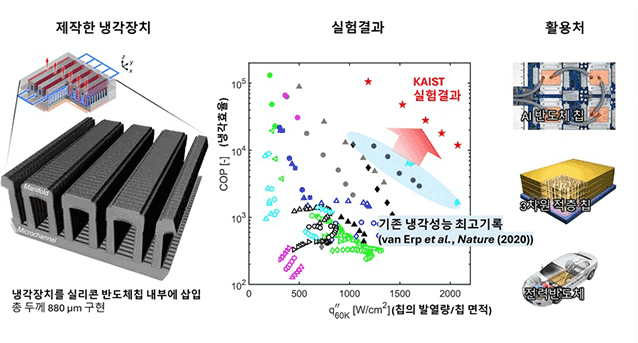
최근 AI 반도체의 고성능화에 따라 발열 문제가 중요해지고 있으며, 이를 해결하기 위한 고효율 냉각 기술의 필요성이 커지고 있다. 연구팀은 기존 매니폴드 마이크로채널(Manifold Microchannel) 냉각 기술의 불균일한 냉각수 분배 및 압력 손실 문제를 해결하기 위해 저비용 1차원 모델과 고정밀 3차원 수치해석을 결합한 다중충실도 모델링 및 최적화 프레임워크를 활용하였다.
최적화된 냉각 구조를 실제 실리콘 칩에 제작하여 실험적으로 검증한 결과, 냉각 효율을 나타내는 성능계수(COP)가 106,000에 도달하였다. 이는 기존 세계 최고 수준 대비 약 10배 향상된 결과로, 동일한 열을 제거하는 데 필요한 펌핑 에너지를 약 10분의 1 수준으로 줄일 수 있음을 의미한다.
본 연구는 다중충실도 기반 최적설계 기술이 실제 첨단 반도체 냉각 시스템의 성능 향상에 효과적으로 활용될 수 있음을 보여주었다. 향후 AI 반도체, 고성능 컴퓨팅 및 데이터센터의 에너지 효율 향상에 기여할 것으로 기대된다.
연구 결과는 국제학술지 Energy Conversion and Management에 게재되었다.
Development of AI Chip Cooling Technology with Tenfold Improvement in Cooling Efficiency Using Multi-Fidelity Optimization
A joint research team led by Professor Ikjin Lee and Professor Sung Jin Kim at KAIST has developed an ultra-high-efficiency liquid cooling technology for next-generation AI semiconductor chips using multi-fidelity modeling and optimization. The research achievement was featured in KBS News and other major media outlets.
To address the increasing thermal management challenges of high-performance AI chips, the research team employed a multi-fidelity modeling and optimization framework that integrates computationally efficient one-dimensional models with high-fidelity three-dimensional numerical simulations. This approach enabled the optimization of a manifold microchannel cooling structure to improve coolant distribution and minimize pumping losses.
The optimized cooling device was fabricated in a silicon chip and experimentally validated, achieving a coefficient of performance (COP) of 106,000. This represents an approximately tenfold improvement over the previous state of the art, reducing the pumping energy required to remove the same amount of heat to approximately one-tenth.
This achievement demonstrates the practical effectiveness of multi-fidelity design optimization for advanced engineering systems. The proposed technology is expected to contribute to energy-efficient thermal management in AI semiconductors, high-performance computing systems, and data centers.
The research was published in the international journal Energy Conversion and Management.