


KAIST 박인규 교수 연구팀, 압력과 전단응력, 홍반을 동시에 측정하는 무선 피부 센서 개발
2026.10.26
admin
KAIST 기계공학과 및 이노코어(InnoCORE) PRISM-AI 연구단 박인규 교수 연구팀은 미국 캘리포니아공과대학교(Caltech) Wei Gao 교수 연구팀, 국립창원대학교 연구팀과 공동으로 피부에 가해지는 압력과 전단응력, 그리고 피부 홍반을 같은 부위에서 동시에 측정하는 무선 광전자 다중모드 피부 센서를 개발했다.
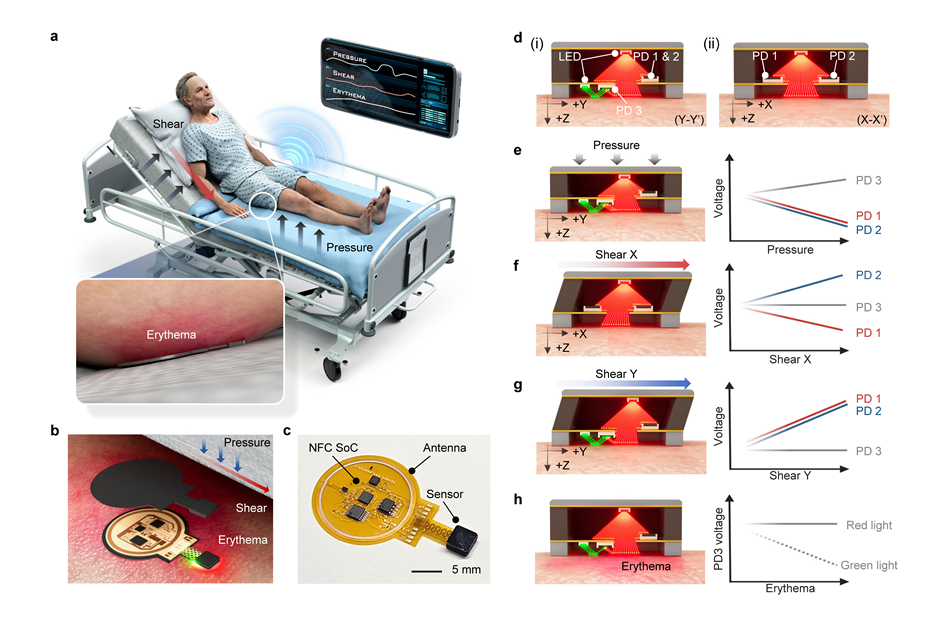
욕창은 장시간 누워 있는 환자의 피부에 압력과 전단응력이 지속적으로 가해져 혈류가 차단되면서 발생하며, 피부가 붉어지는 홍반은 조직 손상의 초기 징후로 알려져 있다. 그러나 현재 임상에서는 의료진이 육안으로 홍반을 판단하기 때문에 조명, 피부색, 관찰자의 경험에 따라 결과가 달라진다. 또한 기존 센서는 수직 압력만 측정하거나 유선 연결이 필요해 피부에 장시간 부착하기 어려웠다.
이에 연구팀은 탄성체 내부의 광학 공동(optical cavity)이 외력에 의해 변형될 때 나타나는 빛의 경로 변화를 세 개의 광검출기로 측정하는 센서 구조를 제안하였다. 압력과 두 방향의 전단응력은서로 다른 신호 패턴을 만들며, 심층신경망(DNN) 회귀 모델을 적용해 3축 힘 성분을 분리하였다(예측 정확도 X축 전단 96.8%, Y축 전단 96.4%, 압력 94.2%). 홍반은 적색과 녹색 두 파장의 빛으로 측정하며, 혈류 증가 시 녹색광 반사량만 선택적으로 감소하는 원리를 이용해 피부의 붉어짐을 정량화하였다. 센서로 측정한 홍반 지수는 상용 피부 색도계의 측정값과 일치하였다.
센서는 근거리무선통신(NFC)으로 전력과 데이터를 주고받아 배터리 없이 작동한다. 연구팀은 병원 침대 환경에서 피험자의 등에 센서 8개를 부착하고, 침대 등받이 각도를 0°에서 60°까지 높이는 동안 부위별 압력, 전단응력, 홍반의 변화를 실시간으로측정하였다.
박인규 교수는 “본 연구는 욕창의 원인이 되는 기계적 자극과 그에 따른 피부 혈관 반응을 같은 부위에서 동시에 측정할 수 있는 기술적 기반을 마련했다는 데 의미가 있다”며, “향후 욕창 고위험 환자를 대상으로 한 장기 연구를 통해 임상적 유용성이 검증된다면, 데이터 기반의 욕창 예방 및 환자 모니터링 분야에 실질적으로 기여할 수 있을 것으로 기대된다”고 밝혔다.
이 성과는 정부(과학기술정보통신부)의 재원으로 한국연구재단의 지원을 받아 수행된 연구임(RS-2026-25476229). 본 연구는 과학기술정보통신부에서 지원하는 과학기술원 InnoCORE 사업에 의해 수행되었습니다.(N10260002).
자세한 정보와 전체 논문은Nature Communications (https://doi.org/10.1038/s41467-026-77832-2)를 참조하세요.
Wireless skin sensor for simultaneous measurement of pressure, shear stress, and erythema
A research team led by Professor Inkyu Park of the KAIST Department of Mechanical Engineering and the KAIST InnoCORE PRISM-AI Center, in collaboration with Professor Wei Gao at the California Institute of Technology and Changwon National University, has developed a wireless optoelectronic skin sensor that measures normal pressure, biaxial shear stress, and erythema at the same skin site.
Pressure injuries result from sustained mechanical loading on the skin of bedridden patients, and erythema is the earliest visible sign of tissue damage. Current clinical assessment relies on visual inspection, which depends on lighting, skin tone, and the experience of the examiner.
The sensor converts the deformation of a soft optical cavity into distinct signals at three photodiodes. A deep neural network regression model separates the signals into triaxial force components, with prediction accuracies of 96.8%, 96.4%, and 94.2% forshear X, shear Y, and pressure, respectively. Red and green light reflectance tracks hemoglobin absorption, and the resulting erythema index agreed with a commercial colorimeter across three human subjects. The device operates without a battery through near field communication.
Eight sensors attached to the back of a participant on a hospital bed recorded the redistribution of pressure, shear stress, and erythema as the bed angle increased from 0° to 60°. The study, with Seokjoo Cho as first author, was published in Nature Communications (Impact Factor 18.1) on 13 October 2026.