


김성엽 교수 연구팀, 물리 기반 베이지안 최적화를 이용한 불확실성 인지 반응성 힘장 개발 논문 게재
2026.09.25
admin
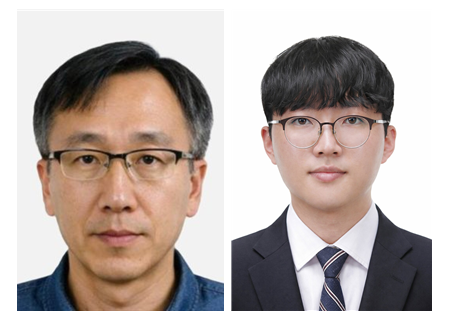
UNIST 기계공학과 김성엽 교수 연구팀(KAIST InnoCORE PRISM-AI 센터)이 물리 법칙을 최적화 과정에 직접 내장한 베이지안 최적화(Physics-informed Bayesian optimization; PIBO) 기법으로, 예측 결과와 함께 그 불확실성까지 정량화하는 불확실성 인지(Uncertainty-aware) 반응성 힘장(Reactive force field; ReaxFF)을 개발한 연구 결과를 계산화학 분야 국제 학술지 Journal of Chemical Theory and Computation(Impact Factor: 5.8, 2025 JCR 기준 상위 9.8%)에 게재하였다. 본 논문은 그동안 연구자의 경험과 시행착오에 의존해온 ReaxFF 매개변수 보정을 물리적으로 타당한 영역 안에서 데이터 효율적으로 수행하고, 보정된 매개변수의 신뢰구간까지 함께 제시하였다는 점에서 학술적 의의를 갖는다.
ReaxFF는 화학 결합의 생성과 파괴를 모사할 수 있어 대규모 반응성 분자동역학 시뮬레이션에 널리 활용되는 원자 간 포텐셜이다. 그러나 원자 하나를 추가할 때마다 서로 강하게 얽힌 100개 이상의 매개변수를 동시에 맞춰야하는 고차원 역문제의 성격을 지녀, 기존 최적화 기법은 물리적으로 허용되지 않는 매개변수 조합에 수렴하는 경우가 잦았다. 김성엽 연구팀은 이러한 한계를 극복하기 위해 매개변수의 부호·양수 조건과 물리적 허용 범위, 안정성 사전정보를 최적화 루프 안에 직접 내장하고, 결합·각도·비틀림·반데르발스·쿨롱 등 각 에너지 항에서의 매개변수 공간을 분할한 뒤, 적응형 가우시안 프로세스 대리모델과 탐색-활용-정밀화로 이어지는 단계별 획득(Acquisition) 전략을 결합한 PIBO 프레임워크를 제안하였다.
이를 2차원 반도체 소재인 이황화몰리브덴(MoS2)에 적용한 결과, 단일 워크스테이션에서 100회의 평가(약 7.9 시간)만으로 밀도범함수이론(Density functional theory; DFT) 수준의 결합·각도·이면각 에너지 곡선을 재현하였다. 특히 학습 데이터에 포함되지 않은 단일층 1H-MoS2 구조에 대해 평형 구조와 단축·이축 응력-변형률 응답을 예측 불확실성 범위 안에서 재현하였고, 황 공공(Vacancy) 형성 에너지를 2.285 eV로 예측하여 DFT 기준값(2.35 eV) 대비 2.8% 이내의 오차를 보였다. 이는 비교 대상이 된 기존 최적화 기법들이 비물리적인 값을 산출한 것과 대비되는 결과이다. 아울러 매개변수 각각의 사후분포를 통해 어떤 DFT 데이터를 추가해야 역장의 신뢰도를 가장 효과적으로 높일 수 있는지를 제시하였다.
본 연구는 과학기술정보통신부에서 지원하는 과학기술원 InnoCORE 사업에 의해 수행되었습니다.(N10250154). 계산 자원은 UNIST 슈퍼컴퓨팅센터의 지원을 받았습니다.
Professor Sung Youb Kim’s Research Team Publishes a Study on Uncertainty-Aware Reactive Force Fields via Physics-Informed Bayesian Optimization
The research team led by Professor Sung Youb Kim at UNIST has published a study in Journal of Chemical Theory and Computation (Impact Factor: 5.8, 2025 JCR Top 9.8%), an international journal in computational chemistry. The study introduces a physics-informed Bayesian optimization (PIBO) framework embedding physical laws directly into the optimization loop to build uncertainty-aware reactive force fields (ReaxFF0, which deliver not only predictions but also quantified uncertainties. The work holds academic significance in that it performs ReaxFF parameter calibration, which has long depended on expert intuition and trial and error, within a physically admissible region in a data-efficient manner.
ReaxFF is an interatomic potential widely used in large-scale reactive molecular dynamics simulations because it can describe the formation and breaking of chemical bonds. However, adding a single atom can require the simultaneous calibration of more than 100 strongly correlated parameters, making it a high-dimensional, ill-posed inverse problem in which conventional optimizers frequently converge to physically inadmissible parameter sets. To overcome this limitation, the team embedded sign and positivity constraints, physical bounds, and stability priors directly into the optimization loop, partitioned the parameter space into energy-term-specific blocks (i.e., bond, angle, torsion, van der Waals, and Coulomb), and combined an adaptive Gaussian process surrogate model with a staged acquisition schedule that progresses from exploration to exploitation and refinement.
Applied to molybdenum disulfide (MoS2), a protopytical two-dimensional semiconductor, the framework reproduced DFT-level bond, angle, and dihedral energy profiles within a budget of only 100 evaluations about 7.9 hours on a single workstation. For a single-layer 1H-MoS2 system held out from training, the calibrated potential reproduced the equilibrium geometry and the uniaxial and biaxial stress-strain responses within its ensemble uncertainty band, and predicted a sulful monovacancy formation energy of 2.285 eV, within 2.8% of the DFT reference (2.35 eV). This contrasts with the established optimizers compared in the study, which returned negative or otherwise nonphysical values. Furthermore, the posterior distributions of all 40 calibrated parameters indicate which additional DFT data would most effectively improve the reliability of the force field.
This work was supported by the InnoCORE program of the Ministry of Science and ICT of Korea (N10250154). We thank the supercomputing resources of the UNIST Supercomputing Center.